

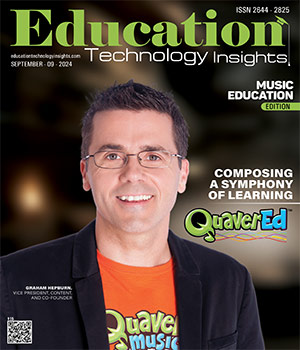

QuaverEd: Composing a Symphony of Learning

Music Education Company of The Year - 2024

In recent years, music education has undergone a profound transformation, driven by technological advancements, a growing emphasis on inclusivity, and the integration of innovative teaching methodologies. As we stand on the cusp of a new era, the landscape of music education is more dynamic and accessible than ever before, offering exciting opportunities for both educators and students.

Perhaps the most significant change in music education is the integration of digital tools and platforms. From online tutorials to sophisticated music production software, technology has democratized access to music learning. Apps like Yousician and Simply Piano have brought instrument learning to the fingertips of millions, allowing students to practice at their own pace and receive instant feedback. Moreover, platforms like Soundtrap and GarageBand enable young musicians to compose, record, and share their music with the world, fostering creativity and collaboration on an unprecedented scale.

Inclusivity has become a cornerstone of modern music education. There is a growing recognition that traditional Western-centric approaches to music education have often marginalized non-Western musical traditions. To address this, educators are increasingly incorporating diverse musical styles and traditions into their curricula, from African drumming to Indian classical music. This not only enriches students' understanding of global music cultures but also fosters a more inclusive learning environment.

The evolution of music education reflects broader societal shifts towards technology, inclusivity, and emotional well-being. As we look to the future, it is clear that the boundaries of what music education can achieve are expanding rapidly. With continued innovation and a commitment to accessibility, the next generation of musicians will be more diverse, creative, and emotionally attuned than ever before.

In this edition, we have featured QuaverEd. The company has set new standards in how music is taught and significantly impacts the lives of tens of millions of students and over 28,000 educators around the globe.

    Music Education Company of The Year

  • QuaverEd stands out as a leader of innovation and excellence in music education. The company has set new standards in how music is taught and significantly impacted the lives of tens of millions of students and over 28,000 educators around the globe.

    www.quavered.com

Social and Emotional Learning FAQ

Q1
What Do Top SEL Tech Solutions Help Schools and Educators Do?
Top SEL Tech Solutions support social and emotional learning by helping students build self-awareness, emotional regulation, relationship skills and responsible decision-making. Many platforms combine lesson delivery, student check-ins, behavior tracking and educator resources in one system. Schools often use these tools to make SEL instruction more consistent across classrooms rather than relying on individual teaching styles. The strongest platforms also help counselors, teachers and families work from the same understanding of student needs. As student wellbeing becomes part of broader school planning, Top SEL Tech Solutions are increasingly tied to attendance, engagement and school climate efforts.
Q2
Why Are Top SEL Tech Solutions Receiving More Attention Across Education?
Schools are dealing with rising concerns around student engagement, emotional wellbeing, classroom behavior and mental health support. At the same time, educators are expected to identify concerns earlier and provide support before problems become larger. Top SEL Tech Solutions help schools create structured approaches to emotional learning while giving staff better visibility into student experiences. Demand is also being shaped by hybrid learning models, larger student support responsibilities and growing expectations from families. In many districts, student wellbeing is now discussed alongside academic performance rather than as a separate initiative.
Q3
How Should Schools Evaluate Social and Emotional Learning Technology Providers?
Schools should look beyond lesson libraries and consider how the platform performs in everyday classroom environments. A useful evaluation often begins with a real-world scenario: how does the system support a student who repeatedly disengages, struggles with emotional regulation or requires follow-up support? Administrators should also review educator training, data privacy practices, reporting quality and family communication features. Integration is another important factor. Many schools already work with multiple learning systems, and adding another disconnected platform can increase the workload for staff. In practice, ease of adoption often makes a bigger difference than the number of features highlighted on a product page.
Q4
What Value Do Top SEL Tech Solutions Create for Students and School Communities?
The value of SEL extends well beyond classroom instruction. Strong SEL programs can help students develop communication skills, resilience, empathy and emotional awareness that support both academic learning and everyday interactions. For educators, structured SEL support can make classroom management smoother and reduce the amount of time spent dealing with recurring behavioral issues. Families also benefit from having a clearer understanding of how emotional learning is being encouraged and reinforced at school. When student support gaps go unnoticed, they can become more challenging over time. Consistent SEL practices help schools recognize concerns earlier and foster more stable, supportive learning environments for students.
Q5
How Are Technology and Innovation Changing Social and Emotional Learning?
Recent SEL platforms are moving beyond static curriculum delivery. Many now include personalized learning pathways, student reflection tools, progress tracking and data-informed intervention support. Some platforms use AI-assisted recommendations to help educators identify patterns that may otherwise go unnoticed. The goal is not to replace human judgment but to help teachers and counselors respond more effectively. Students often need support at different times and in different ways. Technology can help schools organize those efforts, provided the system remains transparent, age-appropriate and easy for educators to interpret.
Q6
What Should Education Leaders Prioritize When Comparing Top SEL Tech Solutions?
Education leaders should focus on practical fit rather than the sheer number of features a platform offers. The most important questions are often simple: Can teachers use the platform consistently in their daily work? Does it encourage meaningful student engagement? Can families participate when needed? Is student data managed responsibly? Schools should also look closely at implementation support, educator training and how progress is tracked over time. Top SEL Tech Solutions are often most effective when they fit naturally into existing school routines rather than creating separate workflows for educators to manage. A platform may look impressive during a demonstration, but long-term adoption usually comes down to whether educators can use it comfortably as part of a busy school day.